Tuesday, February 22, 2022

What Do I Say Meaning In Bengali

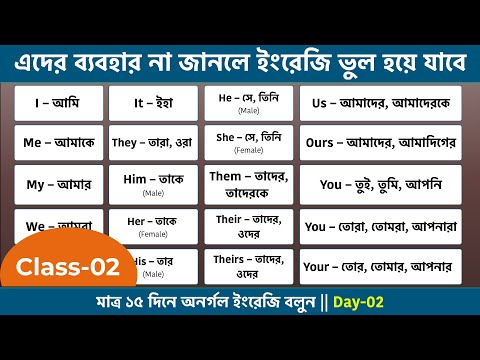
For non-causative verbs , the verbal infinitive and perfect participle forms require stem transformations according to the principles of vowel harmony. Causative verbs only require stem transformations for forming their perfect participles. We are working to develop an application which can help people to translate english words to indian languages with translation, word definition, examples, transliteration, synonyms, antonyms, relevant words and more. Just as in other Indo-Aryan languages, the imperative form of a verb differs on the basis of honorifics. The three sets of second-person pronouns - তুই/তোরা , তুমি/তোমরা , আপনি/আপনারা - combined with slight modifications to the stem of any verb form the imperatives for that verb; these are described in the table below. Note that the plural command forms change the pronoun but not the verb ending.

what do i say meaning in bengali - For non-causative verbs

Bengali is an important community language in the UK. Unfortunately, as the 2001 census did not question languages spoken there is no reliable data to confirm exactly how many Bengali speakers currently live in the UK. However, the 2001 census was translated into 24 different languages, including Bengali. In 2003, the Central Office of Information was commissioned by the Department for Work and Pensions to undertake a review of the ethnic minority languages used by the department.

what do i say meaning in bengali - Causative verbs only require stem transformations for forming their perfect participles

The review aimed to assess the communication needs of each community and recommend the languages into which the DWP information should be translated. Ten key languages were recommended, including Bengali. The Translation People is regularly approached by housing associations and public sector bodies, who request both Bengali translation and Bengali interpreters. 2 December 2020 Updated guidance with information on local restrictions from 2 December. The endings are -bo, -bi, -be, -be, -ben; the তুমি and সে conjugations are identical in this tense, and all forms require stem transformations for vowel harmony.

what do i say meaning in bengali - We are working to develop an application which can help people to translate english words to indian languages with translation

Were and was are both past tense versions of the verb to be. But were is usually used in relation to second person singular and plural pronouns such as you, your, yours. It is also used with select first and third person plural pronouns such as we, they.

what do i say meaning in bengali - Just as in other Indo-Aryan languages

Whereas English features prepositions, Bengali typically uses postpositions. That is, while these modifying words occur before their object in English , they typically occur after their object in Bengali (or pashe, baŗir bhitore). Some postpositions require their object noun to take the possessive case, while others require the objective case ; this distinction must be memorised. Most postpositions are formed by taking nouns referring to a location and inflecting them for locative case. Bengali speech translation service is provided by both Microsoft and Google.

what do i say meaning in bengali - The three sets of second-person pronouns -

They both use their own cognitive services to translate spoken words and phrases into a language of your choice. For some languages, you will hear the translation spoken aloud. Whenever you type a word, sentence or phrase in english - we send API request to either Google or Microsoft for a translation. In return, they send back a response with a translated text in bengali.

what do i say meaning in bengali - Note that the plural command forms change the pronoun but not the verb ending

The Bengali language, also known as Bangla is spoken by approximately 230 million people world wide, the majority of speakers are based in Bangladesh or the Indian state West Bengal. This significant number of speakers makes the Bengali language the 5th most widely spoken language in the world. Bengali belongs to the Indo Aryan family of languages and originates from Sanskrit. Written left to right, top to bottom, as per English, at first glance it appears to be very similar to Hindi. However, some of the words are actually closely related to Latin as well.

what do i say meaning in bengali - Bengali is an important community language in the UK

For example Mother is Mater in Latin, Matar in Sanskrit and Mata in Bengali. These interesting similarities are testament to how all languages are intrinsically linked. Examples are used only to help you translate the word or expression searched in various contexts. They are not selected or validated by us and can contain inappropriate terms or ideas. Please report examples to be edited or not to be displayed. Rude or colloquial translations are usually marked in red or orange.

what do i say meaning in bengali - Unfortunately

As explained earlier, the machine-language technology is used to perform the translation. This translation software is evolving everyday and as a time goes by the translation is going to be pretty accurate - especially for commonly used phrase and sentences. The phrase itself has been a pet peeve for some language commentators. The phrase "I know," on its own, signals that we are aware of something another person is saying, or that we agree with it. According to some critics, adding the word "right" turns the phrase into a question. However, the "right" in "I know, right" is actually just a way of adding emphasis.

what do i say meaning in bengali - However

Using "isn't it" instead of "right" can also work in a similar way. These are typically constructed using the verbal noun along with other nouns or verbs. Demonstrative adjectives - this and that - correspond to এই and ওই respectively, with the definite article attached to the following noun. Their plural forms (these/those) remain the same, with the plurality denoted by the definite article or the classifier.

what do i say meaning in bengali - In 2003

Thus, this book would translate to এই বইটি, while those books would translate to ওই বইগুলো. When counted, nouns must also be accompanied by the appropriate measure word. As in many East Asian languages (e.g. Chinese, Japanese, Thai, etc.), nouns in Bengali cannot be counted directly by adding the numeral directly adjacent to the noun. The noun's measure word must be used in between the numeral and the noun. Most nouns take the generic measure word ţa, although there are many more specific measure words, such as jon, which is only used to count humans. These are typically represented by adding the negative particle না to indefinite pronouns, which are themselves derived from their corresponding question words.

what do i say meaning in bengali - The review aimed to assess the communication needs of each community and recommend the languages into which the DWP information should be translated

Bangla Bækôrôn) is the study of the morphology and syntax of Bengali, an Indo-European language spoken in the Indian subcontinent. Given that Bengali has two forms, চলিত ভাষা and সাধু ভাষা , it is important to note that the grammar discussed below applies fully only to the চলিত form. Shadhu bhasha is generally considered outdated and no longer used in neither writing nor in normal conversation.

what do i say meaning in bengali - Ten key languages were recommended

Although Bengali is typically written in the Bengali script, a Romanization scheme[which? ] is also used here to suggest the pronunciation. Their system use machine-language technologies to bring together some of the cutting edge technologies such as artificial intelligence , big data, Web APIs, cloud computing etc to perform higher quality translations. More than 250 million people around the world speak this language. For the rest who cannot speak the Bangla Language, translating Bengla to English could be quite difficult.
what do i say meaning in bengali - The Translation People is regularly approached by housing associations and public sector bodies

Many websites provide services to translate Bengali for a few dollars. While it is a good idea to pay for translating lots of text and for professional service, there is no point paying for commonly used sentences, greeting messages, and other informal use. 4 November 2020 Updated guidance in line with national restrictions commencing 5 November 2020. Easy-read guidance temporarily removed and will be updated shortly. 9 December 2020 Added British Sign Language videos, large print, audio and translated versions. The present perfect tense is used to relate events that happened fairly recently, or even past events whose effects are still felt in the present.

what do i say meaning in bengali - 2 December 2020 Updated guidance with information on local restrictions from 2 December

It is formed by adding the present progressive tense suffixes with the perfect participle of the verb. The verbal noun can act like a regular noun, and can therefore take case-endings and classifier particles; additionally it can also function as an adjective. Both the verbal noun and the verbal infinitive are often used in constructions where the infinitive is needed. In the simple present tense, there is no verb connecting the subject to the predicative (the "zero-verb" copula).

what do i say meaning in bengali - The endings are -bo

Whereas the verb হওয়া means "to be", the verb আছ- can be roughly translated as "to exist" or "to be present". Nouns are also inflected for case, including nominative, accusative, genitive , and locative. The case marking pattern for each noun being inflected depends on the noun's degree of animacy. The accusative case cannot be inflected upon nouns which are inanimate, and the locative case cannot be inflected upon nouns which are animate. When a definite article such as -ţa (টা, for singular nouns) or -gulo (গুলো, for plural nouns) is added, nouns are also inflected for number. In formal contexts, especially in writing, the definite article -ţa is replaced by -ţi (টি).

what do i say meaning in bengali - Were and was are both past tense versions of the verb to be

There is also an alternative way of using the plural definite article, -gulo, by making it -guli (গুলি). For animate nouns, -gulo/-guli are often replaced by -ra (রা) Below are two tables which show the inflections of an animate noun, ছাত্র chhatrô , and an inanimate noun, জুতা juta . ADB has approved a $250 million policy-based loan to the Government of Bangladesh to help finance reforms aimed at improving the inclusiveness and responsiveness of the country's social development and resilience program. According to Economy Watch, economics experts and various studies conducted across the globe India, alongside China, will rule the commercial world in the 21st Century. India, which is now the fourth largest economy in terms of purchasing power, is set to overtake Japan and become the third major economic power within 10 years. A considerable percentage of the population in India communicate in Bengali on a daily basis.

what do i say meaning in bengali - But were is usually used in relation to second person singular and plural pronouns such as you

If the predictions of Economy Watch prove to be accurate, it will become increasingly important to translate your documents into Bengali and other Indian languages. Say | Bengali dictionary translates English to Bengali and Bengali to English say words say phrases with say synonyms say antonyms say pronunciations. English sentence and phrase will be translated into Bengali meaning. Our English to Bangla Translation Tool is powered by Google Translation API. You can start typing on the left-hand text area and then click on the "Translate" button.
what do i say meaning in bengali - It is also used with select first and third person plural pronouns such as we

Our app then translates your English word, phrase, or sentence into Bengali. The meanings of these two verbs, tell and say, are similar. 1 April 2021 Removed references to national lockdown, updated guidance to reflect lifting of restrictions and vaccine roll out. 1 April 2021 Translations and easy read temporarily removed.

what do i say meaning in bengali - Whereas English features prepositions

For more information, see the developer's privacy policy. Developers should change the top list to be recently used languages for the user, rather than the most popular languages it seems to be basing the list on. The KudoZ network provides a framework for translators and others to assist each other with translations or explanations of terms and short phrases.

what do i say meaning in bengali - That is

There's no exact Bengali word for Hi or Hello. You can say "ki khabor" or "ei je" or "namoskar", depending on the person you areaddressing. But here, with this sentence, I think "ei je" fits most. Designed to be your companion as you enhance and enrich your language skills, Bilingua connects you with other users who are fluent in a language you are learning. Bilingua connects you with native speakers who share your interests or personality to help you learn a foreign language online and speak with confidence.

what do i say meaning in bengali - Some postpositions require their object noun to take the possessive case

Learn and practise English, Chinese, Spanish, French, Japanese and more languages with Bilingua – it's fun, free and effective. This phrase simply means "an apple of the eye/favorite person." Generally grandparents use the phrase for their beloved grandchildren. Another sweet Bengali phrase meaning, we will meet one day. This expression is generally used when one builds up a friendship with a stranger at a random place.

what do i say meaning in bengali - Most postpositions are formed by taking nouns referring to a location and inflecting them for locative case

And people speak it to express the thrill of the rendezvous feeling and the wish to meet in the future. This phrase reveals the Bengali flair for language and literature. Needless to mention, you can find many internationally acclaimed Bengali literary figures. And in general, Bengalis are proficient in at least two major languages. In 1952, a student demonstration at the University of Dhaka led to several deaths and hundreds of injuries in the course of police efforts to quell the protests.

what do i say meaning in bengali - Bengali speech translation service is provided by both Microsoft and Google

Nonetheless, the political efforts paid off and in 1954, Bengali became the official language of Pakistan alongside Urdu. Hence, Bengali language emerged as a symbol of national identity as a consequence of the dedicated struggles of people trying to win legitimacy for a widely spoken language. The fight for Bengali also became one of the inspirations for Bangladesh's independence in 1971. Bengali adjectives form their comparative forms with আরও (aaro, "more"), and their superlative forms with সবচেয়ে (shôbcheye, "than all").

what do i say meaning in bengali - They both use their own cognitive services to translate spoken words and phrases into a language of your choice

Comparisons are formed by using genitive form of the object of comparison, followed by the postposition চেয়ে (cheye, "than") or the postposition মতো (môto, "like") and then by আরও ("more") or কম (kôm, "less"). The word for "more" is optional, but the word for "less" is required, so in its absence "more" is inferred. Adjectives can be additionally modified by using অনেক (ônek, "much") or অনেক বেশি (ônek beshi, "much more"), which are especially useful for comparing quantities. Measuring nouns in Bengali without their corresponding measure words (e.g. aţ biŗal instead of aţ-ţa biŗal "eight cats") would typically be considered ungrammatical. However, omitting the noun and preserving the measure word is grammatical and not uncommon to hear. (lit. "Only one-MW will remain.") would be understood to mean "Only one person will remain.", since jon can only be used to count humans.

what do i say meaning in bengali - For some languages

All of the inflected nouns above have an indefinite article preceding their case markers. There are some basic rules to keep in mind about the cases, apart from the "default" nominative. The relative pronoun যে and its different variants, as shown below, are commonly employed in complex sentences. The relative pronouns for animate objects change for number and honor, but those for inanimate objects stay the same.

what do i say meaning in bengali - Whenever you type a word

The Bengali language proved to be culturally very important to the Bangladeshi people. After the Partition of 1947, Bangladesh lost its educated Hindu class; Bangla or Bengali became a means of identifying their culture and nationalism. When the Pakistani government declared that Urdu would be the only national language, the Bengali language movement campaigned for the recognition of Bengali as a national language. The Bengali language movement contributed to the rise of Bengali literature and is, perhaps, in part, responsible for the huge number of Bengali speakers living today.

what do i say meaning in bengali - In return

Once this translation tool is installed, you can highlight and right-click section of text and click on "Translate" icon to translate it to the language of your choice. Furthermore, you can translate entire web page by clicking on the "Translate" icon on the browser toolbar. If you have any suggestions, and the translated sentence is way too funny then please share with us on our Facebook page. Finally, don't forget to give us a like and share it on Facebook with your loved one. The word /shona/, meaning gold can be used neutrally for a loved one irrespective of gender or your relationship with the person.

what do i say meaning in bengali - The Bengali language

However, it is not used to refer to someone older than you unless the person is your partner. So, the words can be re-ordered to shift emphasis or for poetic requirements. For example, তোমাকে আমি ভালোবাসি (/tomake ami bhalobashi/) may mean, "It is you, whom I love" or ভালোবাসি তোমাকে আমি (/bhalobashi tomake ami/) may mean "It is love what I feel for you". Whether you're curious about or learning the language, or just want to find a new way to express your appreciation of a loved one, this wikiHow will teach you how to say "I love you" in Bengali.

what do i say meaning in bengali - This significant number of speakers makes the Bengali language the 5th most widely spoken language in the world

Hi Dictionary is a bilingual dictionary and learn english app. This Free translator can quickly translate from Bengali to English and English to Bengali (বাংলা-ইংরেজি অনুবাদক) words as well as complete sentences. Instant translation and the full validity of the words. Meaning and definitions of what did you say, translation in Bangla language for what did you say with similar and opposite words. Also find spoken pronunciation of what did you say in Bangla and in English language. Meaning Guru Offers Indian Language Dictionaries with meaning, definition, examples, Translation, pronunciation, synonyms, antonyms and relevant words.

what do i say meaning in bengali - Bengali belongs to the Indo Aryan family of languages and originates from Sanskrit

Wednesday, January 12, 2022

What Is The Meaning Of Verb In English Grammar

The opposite of a transitive verb is an intransitive verb. A verb is an intransitive verb if it is not used with a direct object. Remember, only nouns, pronouns, and noun phrases can be direct objects. Prepositional phrases, adjectives, and adverbs cannot be used as direct objects.

what is the meaning of verb in english grammar - The opposite of a transitive verb is an intransitive verb

Once again, both action and stative verbs can be used as intransitive verbs. Linking verbs are a special type of stative verb whose name gives a big clue as to what they do. Linking verbs are used to link a subject with a subject complement. A subject complement describes or identifies the subject of the sentence or clause. Linking verbs can function as intransitive verbs, which do not take direct objects. Transitive VerbsTransitive verbs are action verbs that always express doable activities that relate or affect someone or something else.

what is the meaning of verb in english grammar - A verb is an intransitive verb if it is not used with a direct object

These other things are generally direct objects, nouns or pronouns that are affected by the verb, though some verbs can also take an indirect object, such as show, take, and make. In a sentence with a transitive verb, someone or something receives the action of the verb. Except for the linking verb list, the other categories break down into different types.

what is the meaning of verb in english grammar - Remember

The list of helping verbs can be auxiliary or modal. The list of irregular verbs shows verbs in different tenses. When an action verb has no direct object, it's called an intransitive verb.

what is the meaning of verb in english grammar - Prepositional phrases

An adverb or adverb phrase can follow intransitive verbs, but there will not be a direct object. Auxiliary verbs are also known as helping verbs and are used together with a main verb to show the verb's tense or to form a question or negative. Common examples of auxiliary verbs include have, might, will. These auxiliary verbs give some context to the main verb, for example, letting the reader know when the action took place. A transitive verb is a verb that is accompanied by a direct object in a sentence. The direct object is the noun, pronoun, or noun phrase that is having something done to it by the subject of the sentence.

what is the meaning of verb in english grammar - Once again

Both action and stative verbs can have direct objects, which means they can both be used as transitive verbs. The three verbals— gerunds, infinitives, and participles—are formed from verbs, but are never used alone as action words in sentences. Instead, verbals function as nouns, adjectives, or adverbs. Helping verbs, also called auxiliary verbs, are helpful verbs that work with other verbs to change the meaning of a sentence. A helping verb combines with a main verb in order to accomplish different goals. These include changing the tense of the verb or altering the mood of a sentence.

what is the meaning of verb in english grammar - Linking verbs are a special type of stative verb whose name gives a big clue as to what they do

What Is Meaning Of Verb In English In these constructions, the "to be" verb will follow the standard rules for subject verb agreement. The examples below have sentences using "to be" verbs in different tenses. Both modals and auxiliaries can be found on a list of helping verbs.

What Is Meaning Of Verb In English

Modals are usually followed by the infinitive of another verb. Just like the list of linking verbs, the list of modals within the list of helping verbs is also small and therefore easy to remember. The being/linking words in the sentences above are included in the being verbs list below. You can use words in the linking verbs list to connect the subject with other words in a sentence.

what is the meaning of verb in english grammar - A subject complement describes or identifies the subject of the sentence or clause

There aren't as many words on a linking verb list as there are on a verb list for mental and physical action words, but each word in the list of linking verbs is nonetheless important. There is a main verb and sometimes one or more helping verbs. ("She can sing." Sing is the main verb; can is the helping verb.) A verb must agree with its subject in number . A noun is a word for a person, place, thing, or idea. Nouns are often used with an article , but not always.

what is the meaning of verb in english grammar - Linking verbs can function as intransitive verbs

Proper nouns always start with a capital letter; common nouns do not. Nouns can be singular or plural, concrete or abstract. Nouns can function in different roles within a sentence; for example, a noun can be a subject, direct object, indirect object, subject complement, or object of a preposition. For the next little while, we're going to focus on main verbs. So, forget about those poor little helping verbs for a bit, and let's turn our attention to action verbs and linking verbs. These two kinds of main verbs can act in four different ways.

what is the meaning of verb in english grammar - Transitive VerbsTransitive verbs are action verbs that always express doable activities that relate or affect someone or something else

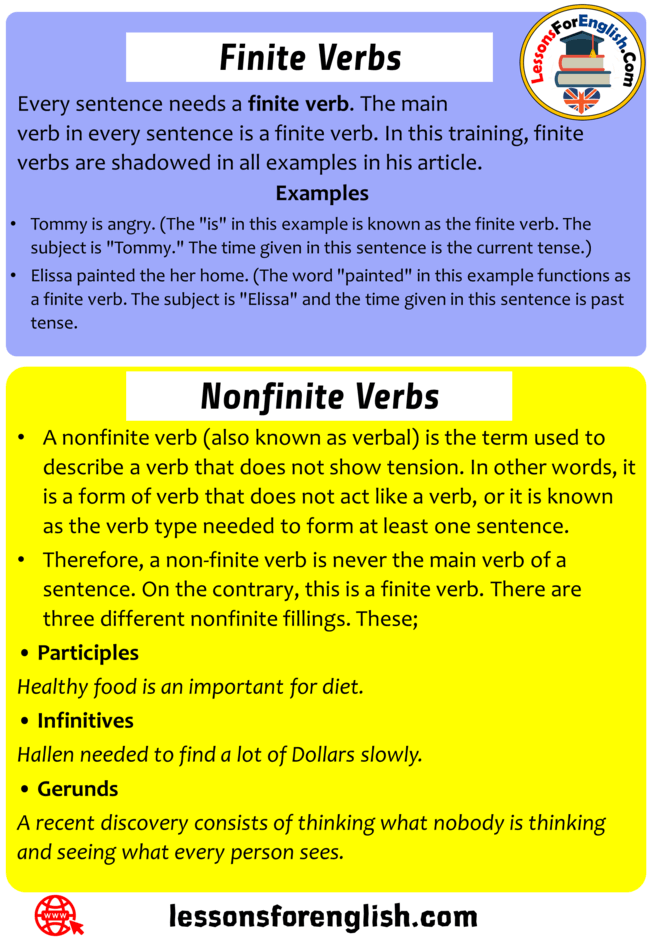
They do not work as verbs in the sentence rather they work as nouns, adjectives, adverbs, etc. Non-finite verbs do not change according to the number/person of the subject because these verbs, also called verbals, do not have any direct relation to the subject. When giving imperatives or commands, "to be" verbs stay in the base form of be and typically stay at the beginning of the sentence. In these sentences, the subject is implied so it doesn't have to be written, that is why you only see the "to be" verb followed by the complement.

what is the meaning of verb in english grammar - These other things are generally direct objects

"To be" verbs change almost more than any other verb. Refer back to this lesson when you have questions about how to use them in the future. A that-clause is a subordinate clause which begins with 'that'.

what is the meaning of verb in english grammar - In a sentence with a transitive verb

That-clauses often function as direct objects of verbs (e.g. 'I hope that you have a nice time') or complements of adjectives (e.g. 'I am glad that you came'). Clauses of this type where 'that' is omitted (e.g. 'I hope you have a nice time', 'I am glad you came') are still described as that-clauses (sometimes specifically as 'zero that-clauses'; see zero). Old English, which was an inflected language, possessed a dative case, and it survived into the Middle English period but then fell almost entirely out of use.

what is the meaning of verb in english grammar - Except for the linking verb list

The objective pronouns reflect a merger of the dative and accusative forms. A word, phrase, or clause that describes or qualifies the meaning of a word. Modifiers include adjectives, adverbs, adverbs, prepositional phrases, participial phrases, some infinitive phrases, and adjective and adverb clauses. Problems arise with dangling modifiers where the agent of the action is not clear. Intransitive verbs are action verbs that always express doable activities. They are different from transitive verbs because there is no direct object following an intransitive verb.

what is the meaning of verb in english grammar - The list of helping verbs can be auxiliary or modal

Our last type of verb isn't actually a verb at all—sorry about that! However, infinitives look a lot like verbs because they are derived from them. An infinitive of a verb is identical to the base form of the verb.

what is the meaning of verb in english grammar - The list of irregular verbs shows verbs in different tenses

For example, the infinitive form of the verb open is open. Typically, we use infinitives with the word to in order to form infinitive phrases. Infinitive phrases can be used for a variety of reasons, such as to act like nouns, adjectives, or adverbs.

what is the meaning of verb in english grammar - When an action verb has no direct object

There are hundreds of grammar rules but the basics refer to sentence structure and parts of speech, including nouns, pronouns, verbs, adjectives, adverbs, prepositions and conjunctions. Future perfect continuous tense functions just like the future perfect tense, except with an ongoing action. The major difference is that with the future perfect tense, the event will have ended, but with the future perfect continuous, the event would still be happening by that time in the future. Both, however, are frequently used with expressions of time.

what is the meaning of verb in english grammar - An adverb or adverb phrase can follow intransitive verbs

Auxiliary verbs, or "helping verbs," are used in English to change another verb's tense, voice, or mood. When auxiliary verbs are used, there's always a main verb that represents the main action. However, the auxiliary verb must still be conjugated correctly. An auxiliary verb extends the main verb by helping to show time, tense, and possibility.

what is the meaning of verb in english grammar - Auxiliary verbs are also known as helping verbs and are used together with a main verb to show the verbs tense or to form a question or negative

To figure out if they are linking verbs, you should try replacing them with forms of the be verbs. If the changed sentence makes sense, that verb is a linking verb. Pronouns referring to one person or thing are singular (I, me, he, it, etc.) as are corresponding possessive adjectives and some determiners (my, his/her/its, this, etc.). Pronouns referring to more than one person or thing are plural (we, us, they, etc.) as are corresponding possessive adjectives and some determiners (our, their, these, etc.). In some inflected languages, the dative case is typically used to indicate nouns and pronouns which function as the indirect object of a verb.

what is the meaning of verb in english grammar - Common examples of auxiliary verbs include have

The words in the linking verbs list are words that connect the subject of a sentence to specific information about the subject. In other words, linking verbs connect the subject to a predicate noun or a predicate adjective. These words could also be included on a list of action verbs describing physical motion. When you don't use these words in the literal sense, they become mental action words. In other words, these words could be found on both a physical and mental action verbs list.

what is the meaning of verb in english grammar - These auxiliary verbs give some context to the main verb

The most common linking verb can be found in the various forms of "to be" (am, are, is, was, were, etc.). Sometimes, the forms of "to be" are helping verbs. A verb that refers to action and links with the subject but does not have an object is called an intransitive verb.

what is the meaning of verb in english grammar - A transitive verb is a verb that is accompanied by a direct object in a sentence

Intransitive verbs don't need an object to complete their proper meaning. Look carefully and you will see that none of these sentences have direct objects. When we write sentences or clauses, we need to include a verb.

what is the meaning of verb in english grammar - The direct object is the noun

A verb is a word that we use to refer to actions and states of being . For example, the words describe, eat, and rotate are verbs. As you are about to see, verbs come in a lot of different types that don't all behave the same way. When using proper grammar, it is important that you use verbs correctly.

what is the meaning of verb in english grammar - Both action and stative verbs can have direct objects

So, we are going to explore the many different types of verbs that we use and how to successfully use them to create great, clear sentences. Some words can be used as linking verbs or action verbs. With these words, it's important to consider the function the verb is performing in the sentence in order to identify the type. The linking "to be" verb describes the condition of the subject. Below are a few sentence structures using the linking "to be" verbs. Verbs are relatively easy to understand, but the key to using them successfully in sentences is being aware of the tense.

what is the meaning of verb in english grammar - The three verbals gerunds

The best way to combat this is by reading the sentence aloud. It's incredibly easy to pick up issues with tenses when you hear it rather than read it. Remember, you can always look back here for more information about how verbs change in tenses to give you an idea about what changes you might need to make to your sentence for it to make sense. And of course, our list of verbs will be here for you to look over for new ideas about which verbs to use in different contexts or for different grammatical functions. A participle is a form of a verb used with auxiliary verbs in complex constructions or alone in non-finite clauses. There are two types of participle in English, past and present.

what is the meaning of verb in english grammar - Instead

An object is a noun, noun phrase, pronoun, or clause which forms the complement of a transitive verb and typically refers to something or someone that is affected by the action denoted by that verb. In some languages, the form of a word varies according to its grammatical function (e.g. whether a noun is singular or plural, or whether a verb is in the present or past tense). These forms are called inflections, and a word which possesses such forms is said to be inflected. For example, in English the word walked is inflected, showing the past tense form of walk; the suffix -ed is an inflectional suffix. Old English, which was an inflected language, possessed an accusative case, and it survived into the Middle English period, but then fell almost entirely out of use.

what is the meaning of verb in english grammar - Helping verbs

The nearest equivalent in modern standard English, the objective case, is marked only in the objective pronouns me, him, etc., which are used as direct objects in sentences such as 'I like him'. The objective pronouns reflect a merger of the accusative and dative forms. Even a casual review of your writing can reveal uses of the verb "To be" that are unnecessary and that can be removed to good effect. In a way, the "To be" verb doesn't do much for you — it just sits there — and text that is too heavily sprinkled with "To be" verbs can feel sodden, static. This is especially true of "To be" verbs tucked into dependent clauses and expletive constructions ("There is," "There were," "it is," etc.).

what is the meaning of verb in english grammar - A helping verb combines with a main verb in order to accomplish different goals

Note that the relative pronoun frequently disappears as well when we revise these sentences. A complete verb includes the main verb and all of the helping verbs. To be considered a verb, it must describe a condition or an action and indicate tense. Linking verbs describe condition and connect a subject to another word. A group of words including a verb and its complements, objects, or other modifiers that functions syntactically as a verb.

what is the meaning of verb in english grammar - These include changing the tense of the verb or altering the mood of a sentence

In English a verb phrase combines with a noun or noun phrase acting as subject to form a simple sentence. Those things that you do for someone or you give to someone are called direct objects. The person who receives the thing is called the indirect object. Unlike action verbs, stative verbs refer to conditions or states of being. Generally speaking, we use stative verbs to describe things like qualities, states of existence, opinions, beliefs, and emotions. When used in a sentence, stative verbs do not refer to actions.

what is the meaning of verb in english grammar - In these constructions

It is important to know that some verbs can be used as either action or stative verbs depending on their meaning in the sentence. We are less likely to use stative verbs in the continuous verb tenses. Helping verbs do exactly what it seems like they should do. That is, they help the main verb of the sentence by extending its meaning.

what is the meaning of verb in english grammar - The examples below have sentences using to be verbs in different tenses

C++ Hsl To Rgb Integer

Rare coloured capsule is the capsule which is combined within the traditional product however with completely different color. To detect thi...